
The Most Common Mistakes in Building Systems Operation
12.10.2026
The building systems in a modern facility form a complex network of equipment, automation, and utilities that directly affects occupant comfort, energy consumption, safety, and overall operating costs. Ventilation, air conditioning, heating, water supply, power distribution, and automation systems may operate for years without major failures, but that does not necessarily mean they are operating correctly or efficiently.
Some problems arise not from design flaws or equipment quality, but during the operational phase. Incorrect settings, deferred maintenance, manual overrides of automated controls, or the lack of systematic data analysis can gradually increase costs and shorten equipment service life. Below, we examine the most common mistakes made in the operation of building engineering systems.
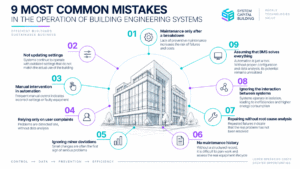
1. Servicing Equipment Only After It Breaks Down
One of the most common mistakes is taking a reactive approach to maintenance: as long as a system is running, no action is taken. For simple, non-critical equipment, this model may sometimes be economically justified. However, when applied to ventilation, cooling, pumping equipment, electrical systems, and other critical building infrastructure, it creates additional risks.
A bearing may gradually wear out, a filter may become clogged, a heat exchanger may lose efficiency, and an electric motor may operate under increased load. The equipment continues to perform its function, but it consumes more resources and moves closer to failure. Scheduled and preventive maintenance makes it possible to identify these changes before they develop into costly emergency repairs.
2. Failing to Adjust Settings When Building Use Changes
A building does not remain unchanged throughout its entire life cycle. Tenants, occupancy levels, operating hours, layouts, and the functions of individual spaces all change over time. Yet building system settings often remain exactly as they were when the facility was originally commissioned.
For example, ventilation may continue to operate according to an outdated schedule even though the office is now occupied for only part of the day. The air-conditioning system may serve a zone whose layout has long since changed. Lighting may follow a single predefined scenario regardless of actual occupancy.
As a result, the building continues to consume resources based on conditions that no longer exist. Following significant changes in the way a facility is used, operating modes should therefore be reviewed and, where necessary, building systems should be recommissioned.
3. Manually “Correcting” Automated Controls
Another common situation is manual intervention in automated systems. Occupants feel cold, so the temperature is raised. It becomes too warm, so it is lowered. A complaint about ventilation comes in, and the operator manually increases airflow.
An individual manual adjustment may be entirely justified. The problem begins when manual intervention becomes the standard method of operating the building.
If automated controls require regular manual correction, the root cause should be identified. It may be a faulty sensor, an incorrectly configured control algorithm, improper system balancing, or a change in actual operating conditions.
Otherwise, the BMS gradually stops functioning as an automated building management system and becomes little more than a convenient interface for manually controlling equipment.
The Most Common Mistakes in Building Systems Operation
4. Relying Solely on Occupant Complaints
Feedback from tenants and staff is an important source of information about building performance. However, it cannot be the only indicator of the condition of engineering systems.
People will quickly notice when an office is too cold, too warm, or poorly ventilated. It is much harder to notice that a pump has been consuming more electricity for several months, that the heat-transfer medium temperature is consistently outside the optimal range, or that a piece of equipment is operating two unnecessary hours every day.
These problems are identified through data rather than complaints. Effective building operation therefore requires monitoring energy consumption, temperatures, pressure, equipment runtime, alarms, and other key parameters.
5. Ignoring Minor Deviations
A major failure attracts immediate attention. A deviation of a few percent usually does not. Yet small changes can be an early warning sign of a developing problem.
A pump begins running for longer periods. A fan starts consuming more electricity. The number of alarms generated by a particular unit gradually increases. The system takes longer to maintain the same temperature.
None of these indicators necessarily points to a serious fault on its own. However, the trend may indicate equipment degradation or an inefficient operating mode. For this reason, effective monitoring should focus not only on threshold values but also on trends over time.
6. Failing to Maintain Equipment Service History
Effective facility operation requires more than knowing what equipment is installed. It is equally important to understand what has happened to each asset over the years.
When was the last scheduled maintenance performed? Which components have been replaced? Does the same fault keep recurring? How many failures occurred during the past year? How much does a particular unit cost to maintain?
If this information is scattered across spreadsheets, paper logs, or simply retained in the memory of technical staff, assessing the actual total cost of ownership becomes difficult. Centralised asset records and maintenance histories make it possible to base decisions on actual data rather than assumptions or intuition.
7. Repairing Equipment Without Root Cause Analysis
If a circuit breaker trips repeatedly, simply resetting it is not enough. If a pump continually fails, replacing the pump again may not solve the underlying problem.
The actual cause may lie elsewhere — in system hydraulics, the electrical supply, incorrect equipment sizing, operating conditions, or automation settings.
Recurring failures should trigger root cause analysis rather than repeated repairs of the same symptom. Otherwise, the technical team continues to address the consequences while the underlying problem remains unresolved.
8. Failing to Analyse How Systems Interact
A modern building is not a collection of independent engineering systems. Ventilation affects heating and cooling loads. Solar shading and lighting influence internal heat gains. Occupancy schedules affect ventilation, climate control, and electricity consumption.
Incorrect settings can sometimes create situations in which one system effectively works against another. Heating and cooling, for example, may operate simultaneously within the same zone. Each system may technically be functioning correctly on its own. The inefficiency lies in the way the systems interact.
For this reason, building infrastructure should be optimised not only at the level of individual pieces of equipment, but at the level of the building as a whole.
9. Assuming That Installing a BMS Automatically Solves the Problem
Having a BMS does not automatically make a building efficient. The system may collect thousands of data points, generate charts, and issue alarms. But if the data is not analysed regularly, alarm thresholds are configured incorrectly, or notifications about minor deviations are routinely ignored, much of the potential value of automation is lost.
A BMS is a tool. The results depend on how well its control algorithms are configured and how systematically the technical team uses the data it provides. The same principle applies to CAFM platforms, energy monitoring systems, and other digital facility management tools.
Efficient Building Operation Starts Before a Repair Is Needed
Most building system problems do not occur overnight. They are usually preceded by deviations, changes in performance indicators, recurring faults, and a gradual decline in efficiency.
Professional building operation, therefore, is not simply the ability to repair equipment quickly after a failure. It is about creating a system that allows problems to be identified before they become failures.
Scheduled maintenance, up-to-date operating modes, automation, comprehensive equipment histories, and continuous data analysis make it possible to move from reactive maintenance to controlled, proactive facility management.
And the key indicator of a well-organised technical operations team is not the number of failures it can resolve quickly, but the number of failures it manages to prevent.