
Where Businesses Lose the Most Money in Building Operations
18.10.2026
High building operating costs do not always mean that a company is simply paying too much for electricity or expensive maintenance services. A significant share of losses can occur in areas that are not even perceived as problems: equipment runs for several unnecessary hours, heating and cooling systems work against each other, preventive maintenance is postponed, and minor faults are addressed only after they lead to a breakdown.
This is particularly noticeable in large facilities — office buildings, shopping centres, hotels, logistics centres, and industrial sites. Even a small inefficiency, multiplied across thousands of square metres and 365 days of operation, can turn into a substantial financial loss.
At the same time, the most expensive losses are often not directly visible in financial statements. Identifying them requires looking beyond utility bills and examining how the building actually operates.
Energy Consumed Without a Real Need
Energy consumption is one of the largest operating cost categories in a modern commercial building. But the issue is not limited to the price of electricity and heat. A more important question is: how much of the energy consumed was actually necessary?
Ventilation may operate at full capacity on weekends. Air conditioning may cool an almost empty floor. Lighting may remain on after business hours. Pumps may operate at levels that do not correspond to the actual load.
Individually, each situation may seem insignificant. Across a large facility, however, they become a source of systematic waste. This is why potential savings often need to be found not by replacing equipment, but by optimising its schedules, operating modes, and control algorithms.
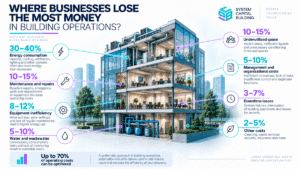
Where Businesses Lose the Most Money in Building Operations
Inefficient Operation of Functioning Equipment
One of the most costly mistakes is assuming that any equipment that continues to operate is working efficiently. There is a significant gap between normal operation and complete failure.
A dirty heat exchanger continues to transfer heat. A fan with worn components continues to move air. A pump with incorrect settings continues to circulate water. However, the equipment may now require more energy to perform exactly the same task. If only breakdowns are monitored, this type of inefficiency can remain unnoticed for months or even years.
Emergency Repairs Instead of Planned Maintenance
Deferred maintenance can sometimes appear to be a saving. If certain maintenance activities are skipped this month, the operating budget will indeed be lower. But the economic impact needs to be assessed over a longer period.
A component that is not replaced on time can damage a more expensive assembly. A minor fault that could have been corrected during scheduled maintenance may turn into an emergency call-out. In addition to the cost of parts, the business then has to pay for urgent work and, in some cases, equipment or facility downtime.
Cheaper maintenance therefore does not necessarily mean lower operating costs. For critical equipment, it is important to consider its total life-cycle cost: maintenance, repairs, energy consumption, spare parts, downtime, and expected service life.
Simultaneous Heating and Cooling
This is one of the clearest examples of how a building can literally spend money working against itself. Incorrect system balancing, automation settings, faulty sensors, or local manual overrides may cause one system to heat a space while another attempts to cool it.
From the occupant’s perspective, everything may appear perfectly normal: the room remains at a comfortable temperature. From an energy perspective, however, resources are being consumed twice. This is why analysing the chiller, ventilation, or heating system separately is not enough. Their interaction must also be monitored and optimised.
Incorrect Operating Schedules
A building’s actual operating schedule often changes much more frequently than the settings of its engineering systems. A tenant moves out, part of a floor becomes vacant, a retail space changes its opening hours, or an office switches to a hybrid working model — yet the automation system continues to operate according to its old schedules.
Even two unnecessary hours of daily ventilation, lighting, or HVAC operation can add up to hundreds of hours of unnecessary operation over the course of a year. And the cost is not limited to energy. It also means additional equipment runtime, faster component wear, and shorter intervals between maintenance activities.
Water: Small Leaks with a Significant Annual Cost
Water consumption is usually smaller than energy consumption in terms of overall operating expenditure, but it has one important characteristic: minor losses can easily go unnoticed.
Leaking plumbing fixtures, faulty valves, irrigation system issues, or problems in process systems may not cause an emergency but can create continuous background consumption. This is why it is useful to analyse not only monthly meter readings but also consumption profiles. For example, consistently high overnight water consumption in an office building may be a reason to inspect the system for leaks or other inefficiencies.
Inefficient Use of Space
Not all operational losses originate directly from engineering systems. A building may be servicing areas that the business does not actually use. A vacant floor may still require partial lighting, heating, cooling, ventilation, cleaning, and maintenance. Fire protection, security, and other essential systems must also remain operational.
This has become particularly relevant for office properties following the widespread adoption of hybrid working models. For this reason, the operating cost per square metre should be considered alongside another metric: how many of those square metres are actually being used by the business?
Downtime Can Cost More Than the Repair Itself
Sometimes the largest financial loss does not appear under the “building operations” budget at all. Imagine that a critical piece of equipment fails. Repairing it costs UAH 100,000. However, because of the failure, part of the facility cannot operate normally for two days. The actual economic impact may significantly exceed the cost of the repair itself.
For a shopping centre, this may mean lost tenant revenue. For an industrial facility, it can mean interrupted production. For a data centre, it may create a critical service risk. For an office building, it may make part of the premises temporarily unusable. Equipment criticality should therefore be assessed not only by the value of the equipment itself, but also by the consequences of its failure.
Lack of Data Also Costs Money
Another source of losses almost never appears as a separate line in the operating budget: the lack of information. If energy consumption is stored in one spreadsheet, maintenance requests in another system, BMS data on a separate platform, equipment history in paper logs, and part of the building knowledge exists only in the minds of technical staff, effective cost management becomes difficult.
In such an environment, a problem may only become visible after it has already affected utility bills or caused a failure. The primary purpose of digitalising building operations is to connect resource consumption, operating modes, equipment condition, maintenance activities, and actual costs.
BMS, CAFM, energy monitoring systems, and analytics platforms do not save money by themselves. What they do is make it possible to see where exactly the building is losing money.
The Biggest Losses Are Systemic
Cost optimisation often begins with negotiating better tariffs, reducing maintenance contracts, or postponing upgrades. However, the greatest potential for improvement may lie elsewhere — in the building’s everyday operation.
Unnecessary operating hours, incorrect settings, gradual deterioration in equipment efficiency, deferred maintenance, and a lack of reliable data can accumulate costs almost unnoticed.
This is why the question “How much does this building cost to operate?” should be supplemented by another: How much of that cost is actually necessary? Answering this question allows a business to move away from mechanical budget cutting and towards systematic management of operational efficiency.