
5 Reasons Why Building Operating Costs Keep Rising
04.10.2026
Building operating costs rarely increase because of one major issue. More often, they are the result of dozens of small inefficiencies: equipment runs longer than necessary, maintenance is deferred, energy consumption gradually increases, and individual engineering systems no longer match the building’s actual operating patterns.
This is particularly evident in large commercial properties — office buildings, shopping centres, hotels, warehouses, and industrial facilities. The more complex the engineering infrastructure, the higher the cost of operating without systematic monitoring and control.
Below are five reasons why operating expenses can continue to rise even when the building itself and the way it is used have not changed significantly.
1. Engineering Systems Gradually Lose Efficiency
Ventilation, air conditioning, heating, pumps, refrigeration equipment, lighting, and other building systems do not operate at the same level of efficiency throughout their entire service life.
Dirty heat exchangers and filters, worn drives, improper system balancing, faulty sensors, or incorrect automation settings may seem like minor issues when considered individually. Together, however, they increase electricity and heat consumption.
For example, a ventilation system may continue to perform its primary function, so there is no obvious failure. At the same time, its fans may be operating at a higher load than originally designed. Nothing appears to have changed for the occupants, but the building owner can already see the difference in utility bills.
This is why assessing equipment simply on the basis of whether it is “working or not working” is not enough. What matters is how efficiently it is operating.
2. The Building Consumes Resources When They Are Not Needed
One of the least visible sources of unnecessary expenditure is excessive equipment runtime.
Lighting may remain on in unoccupied spaces. Ventilation may operate at the same intensity throughout the day. Air-conditioning systems may maintain a set temperature in areas that are not actually being used.
At a small facility, these losses may not seem significant. Across tens of thousands of square metres, however, they can translate into substantial costs.
This is why modern facility operations increasingly rely on automation: Building Management Systems (BMS), occupancy sensors, weather-compensated controls, zoned climate control, and automated equipment operating schedules.
The objective is not simply to consume less. A building should use resources precisely when they are needed and in the amount actually required.
3. Deferred Maintenance Ultimately Costs More
Reducing maintenance expenditure can quickly improve an operating budget — but only on paper.
When equipment is serviced less frequently than required by its maintenance schedule, a minor fault can gradually develop into a repair. A repair can turn into an emergency component replacement. And the failure of a critical system can result not only in direct costs but also in downtime.
The economics of building operations should therefore take into account not only the cost of maintenance itself, but also the total lifecycle cost of the equipment.
Saving, for example, UAH 20,000 on preventive maintenance today is not a genuine saving if it results in a UAH 200,000 repair a year later.
For critical equipment, the transition from a reactive “repair after failure” approach to preventive and predictive maintenance is becoming increasingly important. This means monitoring system performance and condition and intervening before a serious failure occurs.
4. Tariffs Are Rising — But Tariffs Are Not Always the Only Problem
When utility bills increase, the simplest explanation is that electricity, water, heating, or maintenance services have become more expensive. However, tariffs and consumption are two different variables.
If electricity prices increase by 15% while a facility’s electricity costs rise by 30%, it is worth investigating what caused the remaining increase. Possible reasons include changes in operating schedules, equipment degradation, incorrect settings, or higher peak loads.
This is why the total amount on a utility bill alone is not sufficient to assess operational efficiency.
It is more useful to monitor specific performance indicators: kWh per square metre, heat consumption per unit of floor area, water consumption per occupant, maintenance costs per square metre, and similar metrics.
This makes it possible to distinguish between external increases in resource prices and internal inefficiencies within the building itself.
5. There Is No Unified System for Operational Data
The most complex problem is often found not in the boiler room or ventilation plant room, but in management.
Meter readings may be stored in one spreadsheet, maintenance requests in another system, equipment information in technical documentation, and expenditure data in accounting software. Meanwhile, some of the most important knowledge about the facility may exist only in the head engineer’s experience.
As a result, the owner can see the total operating cost but may not be able to quickly answer three simple questions: Where did the overspending occur? When did it begin? What caused it?
This is one of the reasons for the growing adoption of energy monitoring systems, BMS, Computer-Aided Facility Management (CAFM) platforms, and other digital facility management tools. They enable organisations to move from analysing bills after the fact to continuously monitoring operational performance.
Automation alone, however, does not guarantee savings. It is essential to establish baseline performance indicators, define acceptable deviations, and regularly analyse the reasons behind any changes.
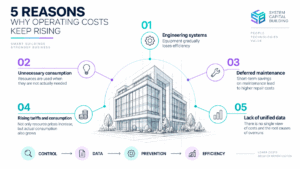
5 Reasons Why Building Operating Costs Keep Rising
Витрати потрібно не скорочувати, а контролювати
Найдешевша експлуатація не обов’язково є найефективнішою. Надмірне скорочення сервісних робіт, персоналу або профілактики може лише перенести витрати на майбутнє — і зробити їх значно більшими.
Тому правильніше говорити не про постійне скорочення операційних витрат, а про керування вартістю експлуатації. Для цього потрібно бачити реальне споживання ресурсів, контролювати ефективність інженерних систем, планувати обслуговування та порівнювати показники об’єкта в динаміці.
Якщо витрати постійно зростають, перше питання має звучати не «де ще можна заощадити?», а «що саме стало коштувати дорожче і чому?». Відповідь на нього часто і показує найбільший потенціал для оптимізації.