
7 Signs Your Building’s Engineering Systems Need an Audit
04.11.2026
Building engineering systems can operate for years without major failures, but that does not necessarily mean they remain efficient and reliable. Equipment wears out, operating conditions change, individual systems are upgraded, and the actual condition of a facility gradually begins to differ from the original design. As a result, many issues become visible only when they lead to significantly higher operating costs, recurring failures, or the need for urgent repairs. A technical audit helps identify these changes early and determine where and why a facility is losing efficiency.
1. Operating Costs Are Rising Without an Obvious Reason
If electricity, heating, cooling, or water costs continue to increase while the building’s operating conditions remain largely unchanged, it may be time to assess the performance of its engineering systems. Possible causes include incorrect automation settings, worn equipment, improper system balancing, or different systems operating in conflicting modes. For example, heating and cooling systems may partially counteract each other, increasing energy consumption without producing any noticeable benefit. An audit helps identify the source of excessive consumption rather than simply recording higher utility bills.
2. Failures and Minor Malfunctions Keep Recurring
A single equipment failure does not necessarily indicate a systemic problem. However, if pumps, sensors, automation equipment, valves, or other components repeatedly require repairs, addressing each failure individually may no longer be enough. Recurring faults are often caused by incorrect operating modes, deterioration of the engineering network, or problems elsewhere in the system. In this situation, it is more effective to inspect the entire interconnected engineering system rather than focusing on a single component.
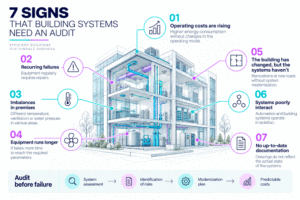
Discover 7 signs your building needs an engineering systems audit, from rising energy costs and equipment failures to automation and integration issues.
3. Conditions Vary Across Different Areas of the Building
Temperature differences, insufficient ventilation, fluctuations in water pressure, or recurring complaints from occupants in particular areas may indicate that the systems are improperly balanced. Such problems are often addressed locally by adjusting settings, adding equipment, or increasing system capacity. However, these measures can simply shift the imbalance to another part of the building rather than eliminate its underlying cause. A technical audit provides a comprehensive assessment and helps determine what is actually causing these deviations.
4. Equipment Runs Longer or More Frequently Than Before
A ventilation unit, pump, or air-conditioning system may remain technically operational while taking increasingly longer to achieve the required parameters. For a business, this means additional energy consumption, accelerated equipment wear, and a gradual increase in operating costs. The equipment itself is not always the source of the problem: clogged filters, incorrect balancing, faulty sensors, or inefficient automation algorithms may also be responsible. Before replacing expensive equipment, it is therefore important to assess the entire system and its operating logic.
5. The Building Has Changed, but Its Engineering Systems Have Not
Office reconfiguration, an increase in the number of employees, changes in the use of premises, installation of new production equipment, or expansion of warehouse areas can significantly affect engineering loads. Systems designed for the building’s original operating conditions may no longer meet its actual requirements. This is particularly relevant for ventilation, air conditioning, power supply, security systems, and automation. Following significant changes to a facility, an engineering systems audit can determine whether the existing capacity remains sufficient and whether modernization is required.
6. Systems Operate Separately and Do Not Interact Properly
In a modern facility, ventilation, power supply, automation, fire safety, access control, and building management systems should not function as isolated technological islands. Their correct interaction is particularly important during emergency scenarios, when a single event must automatically trigger a predefined sequence of actions. If equipment has been upgraded at different times or by different contractors, the original interaction logic may gradually become fragmented or compromised. A comprehensive assessment makes it possible to evaluate not only the performance of each individual system but also the effectiveness of their integration.
7. No One Has a Clear Picture of the Actual Condition of the Systems
One of the clearest warning signs is the absence of up-to-date information about the facility’s engineering infrastructure. As-built documentation may no longer reflect the actual location or configuration of equipment, some diagrams may be missing, modifications may not have been documented, and critical knowledge about the facility may exist only in the experience of long-serving maintenance personnel. Under these conditions, even a relatively minor modernization project can become complicated and expensive. An audit helps document the current condition of engineering systems, identify critical areas, and establish a reliable basis for future maintenance and facility development.
Audit Before a Failure Occurs
A technical audit of engineering systems should not be viewed solely as a response to a critical failure. It is an effective facility management tool that helps assess the actual condition of equipment, identify the causes of excessive operating costs, detect potential risks, and establish modernization priorities. For building owners and facility management companies, it also provides an opportunity to plan capital expenditures in advance instead of financing urgent repairs after another unexpected failure. The more complex the facility and its engineering infrastructure, the more important a systematic approach to technical assessment becomes.