
5 Mistakes That Shorten Equipment Service Life
10.11.2026
Engineering equipment rarely fails suddenly without any warning signs. In most cases, the service life of systems is gradually reduced by improper operating conditions, delayed maintenance, or incorrect settings. For commercial, industrial, and warehouse facilities, this means not only additional repair costs but also the risk of downtime and disruption to other interconnected systems. Extending equipment service life therefore begins not with replacing components, but with properly organized operation and maintenance.
1. Servicing Equipment Only After a Failure
One of the most common mistakes is repairing equipment only after it has stopped working or started showing obvious signs of malfunction. This approach may appear cost-effective, but even a minor deviation in the operation of one component can create additional loads on other parts of the system. As a result, instead of routine maintenance, a business may face more complex repairs or premature equipment replacement. Regular diagnostics help identify wear before it develops into a serious failure or emergency.
2. Operating Equipment Under Incorrect Conditions
Even high-quality equipment is designed to operate within specific parameters, and continuously exceeding its intended load reduces its service life. This may result from changes in building use, an increased number of users, space reconfiguration, or incorrect automation settings. At the same time, the problem is not always obvious: the system may continue performing its function while operating for longer periods, starting more frequently, or constantly running close to maximum capacity. Monitoring actual operating conditions makes it possible to identify these deviations early and adjust system performance accordingly.
3. Ignoring Minor Performance Deviations
Unusual noise, vibration, unstable temperatures, sensor errors, or occasional automation alerts are often treated as minor inconveniences. In reality, these signals may indicate component wear, improper balancing, or incorrect operating conditions. The longer equipment continues to operate with such deviations, the greater the risk that the problem will affect interconnected components and systems. Technical condition should therefore be assessed not only according to whether equipment is operational, but also according to the stability of its key performance parameters.
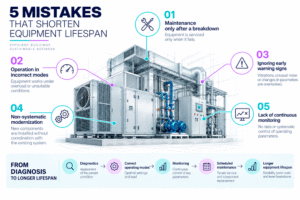
Discover five common operating and maintenance mistakes that shorten equipment service life, increase repair costs, and raise the risk of unexpected failures.
4. Unsystematic Modernization
Replacing an individual pump, ventilation unit, controller, or other component does not necessarily improve the performance of the entire system. New equipment may have different specifications, control requirements, or operating modes that were not considered when the existing infrastructure was originally designed. When modernization is carried out in isolation, new and existing components may operate inefficiently or even conflict with one another. Before replacing critical components, it is important to assess their compatibility with other engineering systems and determine whether corresponding changes to automation and control systems are required.
5. Lack of Continuous System Monitoring
If information about equipment performance is collected only during scheduled inspections or after users report a problem, many deviations may remain unnoticed. Automated monitoring and control systems make it possible to track key parameters, record alarms, and identify changes in equipment performance over time. This allows technical teams to respond not only to an actual failure but also to trends that may eventually lead to one. For complex facilities, continuous monitoring becomes an important element of preventive maintenance and helps improve the predictability of engineering system operation.
How to Extend Equipment Service Life
The durability of engineering equipment depends on more than the manufacturer or the initial quality of the system. Proper operating conditions, regular technical maintenance, continuous performance monitoring, and timely correction of deviations all play an important role. For building owners and facility management companies, a systematic approach makes it possible to plan repairs and modernization instead of responding to them under emergency conditions. In the long term, this helps reduce emergency repairs, avoid unexpected downtime, and use the available equipment resource more efficiently.