
6 Signs Your Building Is Losing Energy Efficiency
09.09.2026
A building’s energy performance does not remain constant throughout its entire service life. Aging materials, deteriorating seals, changes in insulation performance, inefficient building systems and changing occupancy patterns can gradually increase the amount of energy required to maintain comfortable indoor conditions.
The problem is that declining building energy efficiency is not always immediately visible. A property may appear to be in good condition while its heating, cooling and ventilation systems are already consuming more energy than necessary. Several warning signs can indicate that a building should undergo a more detailed energy performance assessment.
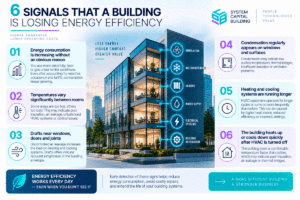
1. Energy Consumption Is Increasing Without a Clear Reason
A sustained increase in energy consumption under comparable operating conditions is one of the clearest warning signs. The total cost shown on an energy bill is not always a reliable metric because tariffs can change. A more accurate assessment compares actual consumption — electricity in kWh, gas volumes or delivered thermal energy.
Weather conditions, heating and cooling degree requirements, occupancy, operating hours and changes in floor area should also be considered. If a building consistently requires more energy to maintain the same indoor conditions after these variables are accounted for, its envelope or mechanical systems may be performing less efficiently.
For commercial properties, tracking energy use per square meter or another normalized energy-use intensity metric can make long-term changes easier to identify.
2. Temperatures Vary Significantly Between Rooms
An energy-efficient building should maintain reasonably consistent thermal conditions without requiring excessive heating or cooling. When one room is consistently too warm while another remains cold, the thermostat may not be the only issue.
Uneven temperatures can indicate inadequate insulation, air leakage, poor HVAC balancing, duct problems or control-system faults. Cold areas around exterior walls, windows, roofs, floors or structural junctions deserve particular attention.
These locations can indicate thermal bridges — parts of the building envelope where heat flows more readily than through surrounding assemblies. The result is not simply reduced comfort. HVAC equipment may have to consume additional energy to compensate for local heat losses or gains.
3. Drafts Appear Around Windows, Doors and Building Joints
Uncontrolled air infiltration is a common source of wasted energy. Outdoor air can enter through gaps around windows and doors, penetrations for utilities, connections between building components and other weaknesses in the envelope.
During winter, the heating system must compensate for incoming cold air. During summer, air conditioning equipment must deal with unwanted warm and potentially humid outdoor air.
Controlled ventilation and accidental infiltration should not be confused. Ventilation introduces outdoor air at a planned rate to maintain indoor air quality. Infiltration occurs through uncontrolled gaps and generally represents an additional heating or cooling load.
A draft around a single window may indicate a localized seal problem. Drafts across multiple areas of a property, however, can point to broader deficiencies in envelope airtightness.
4. Condensation Regularly Appears on Windows or Building Surfaces
Condensation does not automatically mean a building is energy inefficient. It occurs when a surface temperature falls below the dew point of the surrounding air. However, persistent condensation on the interior side of windows, external walls, corners or window reveals can indicate a problem that deserves further investigation.
Potential causes include low surface temperatures caused by inadequate insulation, thermal bridging, poorly performing windows or insufficient ventilation.
Persistent moisture can also affect finishes and building materials, making it important to identify the underlying cause rather than simply removing visible condensation. A proper assessment should therefore consider indoor temperature and relative humidity, surface temperatures and ventilation performance together.
5. Heating and Cooling Systems Run for Longer
Changes in HVAC operating patterns can provide another indication of declining building energy efficiency. If equipment that previously maintained comfortable conditions begins running for longer periods or cycling more frequently, the building may require more energy to meet the same heating or cooling demand.
The HVAC equipment itself is not necessarily the source of the problem. Higher loads can result from increased air leakage, deteriorating insulation or additional internal and solar heat gains. Alternatively, the system may have developed its own efficiency problems, such as dirty filters, poor balancing, damaged duct insulation, faulty sensors or aging components.
This is why replacing heating or cooling equipment without diagnosing the building as a whole can be inefficient. The first question should be why the load has increased.
6. Indoor Temperatures Change Quickly When HVAC Is Off
How quickly a building loses comfortable indoor conditions can reveal useful information about its thermal performance. If rooms cool rapidly after heating is switched off in winter, or become hot soon after air conditioning stops in summer, the building may be exchanging heat with the outdoor environment too quickly.
Potential causes include inadequate roof or wall insulation, poorly performing windows, air leakage, thermal bridges and excessive solar heat gain. This observation becomes particularly useful when compared with historical performance.
If a building maintained indoor temperatures for longer under similar weather and operating conditions in the past, a noticeable change can justify further investigation.
How to Identify Where Energy Is Being Lost
Individual warning signs cannot determine the exact cause of declining energy performance. A cold room, for example, could result from poor insulation, air leakage, an HVAC distribution problem or a combination of all three.
Professional energy assessments therefore evaluate the building as an interconnected system. An assessment can include analysis of utility consumption, inspection of the building envelope and mechanical equipment, evaluation of insulation, examination of HVAC operating schedules and testing for uncontrolled air leakage.
Diagnostic tools can provide more detailed evidence. Infrared thermography can identify surface-temperature anomalies and potential envelope defects, while a blower door test can measure overall building airtightness and help locate uncontrolled air leakage.
For larger commercial properties, the process can also include building automation data, ventilation schedules, lighting systems, equipment sequencing and energy consumption during unoccupied hours.
Why Building Energy Efficiency Requires Continuous Monitoring
Energy efficiency is not simply a specification established when a building is designed or constructed. Actual performance depends on the condition of the envelope, the efficiency of mechanical systems, maintenance practices and how the property is operated.
Rising energy consumption, uneven temperatures, drafts, condensation, longer HVAC operating cycles and rapid changes in indoor temperature should therefore be treated as diagnostic signals rather than isolated comfort complaints.
Identifying the underlying cause early allows owners and facility managers to prioritize the right improvements — whether that means air sealing, restoring insulation, balancing HVAC systems or carrying out a broader building retrofit.
A systematic approach can reduce energy consumption while also preventing unnecessary capital expenditure on equipment that may simply be compensating for problems elsewhere in the building.